Colorful Star: A Bright, Practical Embroidery Design Worth Your Thread
First Impressions: Simple Charm, Not Overworked Cuteness
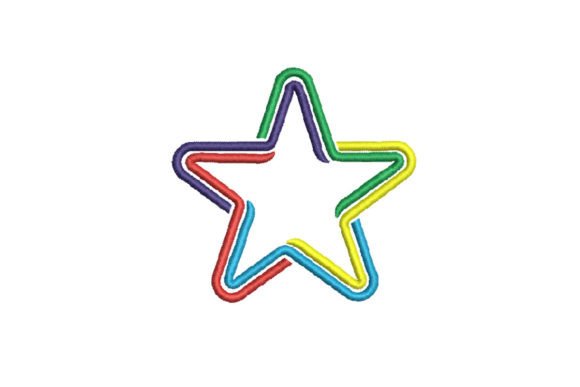
When I opened Colorful Star for the first time, what struck me wasn’t complexity—it was clarity. This isn’t a fussy star with tiny points or layered gradients. It’s a clean, friendly shape with gentle curves and balanced proportions—exactly the kind of machine embroidery design that reads well at 2–3 inches wide on a tote bag or baby onesie. The “colorful” in the title isn’t just marketing; it invites thoughtful thread selection. You can lean into cheerful contrast (think lime green on navy) or keep it soft (pale yellow on oatmeal linen), and Colorful Star holds up either way. It feels joyful without tipping into juvenile—equally at home on a nursery pillow cover or a boutique apron for a local coffee shop.
A Real-World Test: Stitching It onto a Linen Tea Towel
Last week, I used Colorful Star to embroider a set of kitchen towels for a small shop client. We chose medium-weight natural linen—textured, slightly uneven, and unforgiving of dense stitch areas. I hooped it with tear-away stabilizer (lightweight cutaway would’ve been overkill), tested on scrap first, and ran the design at 2.8 inches wide. The result? Crisp satin-stitched edges, smooth fill-stitch centers, and zero puckering—even across the fabric’s subtle slubs. No floating threads. No skipped stitches. That tells me Colorful Star has smart stitch density: enough coverage to read clearly on fabric, but not so much that it overwhelms delicate weaves or adds stiffness where you don’t want it.
Where It Shines—and Where It Needs Thought
Colorful Star works beautifully on custom apparel like sweatshirts and lightweight cotton tees—especially when placed on the chest or sleeve cuff. Its scale and openness mean it won’t get lost under ribbing or stretch. On baby embroidery? Perfect. It reads instantly on a onesie front or bib corner, and the rounded points avoid sharp visual tension. As an embroidered patch? Yes—but only if you’re using a stable twill or denim backing. Don’t try it on ultra-thin silk or jersey without testing stabilizer layers first.
That said, tread carefully on curved surfaces like caps or hats. The star’s symmetry relies on even tension—so if your hoop doesn’t sit flat on the crown, the top point may distort slightly. And while it’s forgiving on dark fabric (thanks to generous stitch coverage), avoid pairing pale pastel threads with black fabric unless you pre-test for visibility. Also: skip Colorful Star for tiny hoop sizes under 3”x3”—the inner details lose definition, and the outer satin edge starts to feel thin.
What It Adds to Your Finished Product
This is where Colorful Star quietly earns its place in your design assets. It elevates handmade product perception—not by shouting “look at me,” but by feeling intentional. Customers notice that polish: the even spacing between points, the slight taper on each arm, the way the fill stitch nests cleanly inside the satin border. That level of execution builds trust. A personalized gift stitched with Colorful Star feels cared-for, not mass-produced. For Etsy sellers and small shop owners, it’s a reliable anchor design—you can pair it with monograms, seasonal motifs, or minimalist text and still keep brand consistency. And because it’s versatile in tone, it fits holiday embroidery (think red/green stars on stockings) and wedding gifts (ivory/gold on linen napkins) without needing redesign.
Designer Notes You’ll Actually Use
- Always test on scrap fabric first—especially if you’re stitching on textured or stretchy material. Linen, terry cloth, and French terry all behave differently.
- Check thread color contrast early. Run a quick black-and-white mockup to see how legible the shape stays without color cues.
- Review stitch density visually before sending to your machine. Look for tight clusters that might cause fabric distortion or excessive bulk.
- Confirm hoop size compatibility. If your smallest hoop is 4”x4”, Colorful Star will fit comfortably—but double-check the file’s actual dimensions before scaling down.
- Inspect small details at 200% zoom: Are the star’s inner corners fully digitized? Is there any stray running stitch? Most well-made embroidery files clean up fast—but it’s faster to catch it now than unpick it later.
- Use proper stabilizer for your fabric type. Tear-away for stable wovens, cutaway for knits, and fusible + tear-away for lightweight silks or voiles.
- Verify licensing before selling finished items. Since Colorful Star is marketed as a machine embroidery design for kids and adults alike, confirm whether commercial use is included—especially if you plan to list embroidered tote bags or pillow covers on Etsy.
Final Thought: A Design That Serves the Project, Not the Other Way Around
Colorful Star doesn’t demand attention—it earns it. It’s the kind of embroidery file you reach for when you need something cheerful but grounded, simple but not basic, colorful but never chaotic. Whether you’re building a line of nursery decor, restocking your craft fair table with embroidered tea towels, or adding a signature touch to custom sweatshirt orders, this design supports your vision instead of competing with it. It’s not flashy—but in the quiet confidence of its execution, in the way it holds up after washing, in how customers pause and smile at its warmth—that’s where its real value lives. For designers, makers, and small business owners who choose every stitch with intention, Colorful Star is more than decoration. It’s dependable design language—stitched, tested, and ready.