Fingerprints Heart: A Wedding Embroidery Design Review
First Impression: Warm, Intimate, and Professionally Handmade
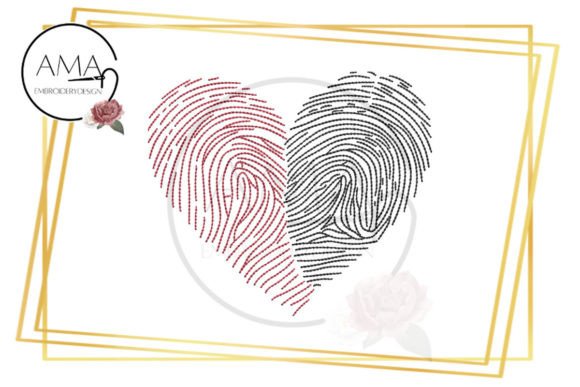
As an embroidery designer who’s developed hundreds of commercial designs for small businesses, my first reaction to Fingerprints Heart is immediate recognition of its emotional intelligence. It’s not just a heart—it’s a visual metaphor for connection, crafted with two fingerprints that suggest authenticity, individuality, and shared commitment. The title alone signals warmth and human scale, making it feel friendly yet elegant—ideal for wedding-themed brands, but also unexpectedly versatile for lifestyle-focused small business merch. It reads as modern and handmade at once: clean enough for boutique packaging, expressive enough for apron embroidery or custom apparel.
Real-World Business Use: Where Fingerprints Heart Shines
This machine embroidery design excels in contexts where brand intimacy matters. Think of a local florist embroidering Fingerprints Heart on the chest of staff aprons—subtle, meaningful, and instantly memorable. A craft bakery could stitch it onto linen tote bags handed to customers with their first order, reinforcing a personal promise rather than generic branding. For Etsy sellers, it works beautifully as a branded embroidered patch sewn onto handmade product tags or packaging accents, adding tactile credibility to digital listings.
In apparel decoration, Fingerprints Heart performs exceptionally well as a cap embroidery motif (center front or side), especially when scaled to 2.5–3 inches. Its balanced shape and clear negative space allow it to hold structure even on curved surfaces like baseball caps or tote bag handles. On uniforms for creative studios or wedding planning businesses, it reads clearly at sleeve or pocket placement without overwhelming the garment. As a standalone embroidered patch, it conveys unity and care—perfect for team-building gifts, bridal party keepsakes, or customer loyalty tokens.
Careful Application: Know Its Limits Before Production
While Fingerprints Heart is thoughtful in concept, its fingerprint detail demands attention in execution. At under 1.75 inches tall, the ridges may blur or lose definition—especially on textured fabric like canvas tote bags or unbleached cotton aprons. Avoid placing it on high-wear zones like shirt cuffs or backpack zippers unless you’ve tested durability across multiple wash cycles. Dark uniforms require careful thread color selection: light-toned threads must have sufficient contrast, and metallics may compromise the organic feel.
High stitch density near the fingerprint edges can cause puckering on lightweight fabrics or stiffen patches meant for flexible wearables. Always confirm hoop size compatibility before digitizing—some versions may require larger hoops than standard 4×4” setups, which affects production speed and cost for small batch runs. And never assume it’s optimized for curved cap fronts without testing: slight distortion in the heart’s symmetry can weaken the emotional impact.
Brand Identity Impact: More Than Just a Symbol
Fingerprints Heart strengthens brand identity by anchoring abstract values—love, trust, partnership—into tangible, stitched form. Unlike generic hearts or monograms, it implies co-creation and mutual presence. That builds customer trust, especially for service-based small businesses: a pet brand using it on adoption kits or a boutique offering “fingerprint + name” gift sets signals deep personal investment. Visually, it supports consistency across touchpoints—from printable mockups used in social media ads to finished product photography—without needing supporting text.
For handmade product sellers, this embroidery file adds perceived value. Customers equate hand-stitched or precisely machine-embroidered details with quality and intentionality. When paired with neutral palettes and natural fibers, Fingerprints Heart elevates merchandise from promotional item to keepsake. It also encourages engagement: clients often ask about its meaning, creating organic storytelling opportunities on Instagram captions or packaging inserts.
Practical Designer Notes for Commercial Use
Before launching any project with Fingerprints Heart, follow these proven steps:
- Test it in black and white first—many subtle tonal shifts disappear when converted to single-color thread, revealing spacing or density issues.
- Check minimum viable size: run a 1.5-inch version on your embroidery software and zoom in—do the fingerprint lines remain distinct?
- Review thread color contrast against your base fabric—especially on dark or heathered materials where light thread may recede.
- Inspect spacing between fingerprint arcs and heart outline—tight gaps can collapse during stitching or washing.
- Confirm hoop size requirements; mismatched hoops lead to re-hooping delays and registration errors in multi-position work.
- Test on real fabric—not just stabilizer swatches—with your intended needle, thread weight, and machine tension settings.
- Use cutaway stabilizer for woven fabrics and tear-away for knits; skip fusible-only options unless backing is fully enclosed.
- Create a printable mockup for client approval before digitizing—this avoids costly revisions post-production.
- Compare Fingerprints Heart beside your existing design assets—does it harmonize with fonts, logos, and other embroidery files in tone and scale?
- Verify commercial licensing status before use in client projects or resale items—this is non-negotiable for small business merch and digital embroidery file distribution.
Final Thought: A Quietly Powerful Tool for Story-Driven Brands
Fingerprints Heart isn’t flashy—but that’s its strength. In a crowded market of loud logos and trend-chasing graphics, it offers quiet resonance. For wedding designers, it fits naturally. But its true power lies beyond the Wedding Designs category: it’s a flexible, emotionally intelligent embroidery file that helps small businesses say “we see you” without saying a word. Whether stitched onto a barista’s apron, a florist’s delivery tote, or a handmade soap label, Fingerprints Heart transforms functional embroidery into brand language—stitched, sincere, and built to last.